Italian-American Heritage Month The Journey, Legacy, and Lasting Impact
Every October, Italian-American Heritage and Culture Month invites the United States to remember a story that began long before Ellis Island became a symbol of arrival. It is a story of movement, work, faith, family, language, food, artistry, struggle, and belonging.
It is also a story of two countries whose connections run deep. Italy and America have shaped each other through diplomacy, migration, culture, trade, and generations of people who carried one home in their memory while building another with their hands.
Italian-American Heritage Month is not only a celebration of what Italian Americans have contributed. It is a chance to understand how those contributions were made, often through hardship, and why they still matter today.

The relationship began before the great migration
The connection between Italy and America did not begin with the massive immigration waves of the late 1800s and early 1900s. It started earlier, through ideas, craftsmanship, politics, and admiration.
In the early United States, Italian artistry held a special appeal. Thomas Jefferson admired Italian architecture, design, and classical forms. At Monticello, Italian artisans and skilled workers helped shape spaces that reflected this influence. Their work pointed to something larger: even in the young republic, Italy represented beauty, precision, and cultural depth.
The political relationship also has deep roots. After Italy’s unification, the United States recognized the Kingdom of Italy in 1861. That recognition marked a formal step between two nations, but the human relationship would soon become much larger than diplomacy.
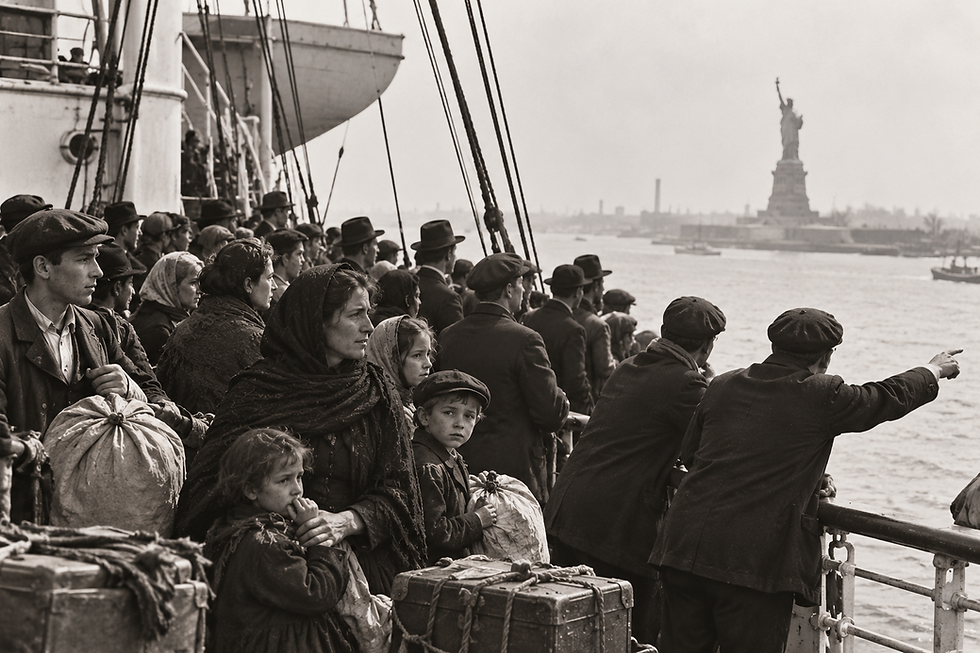
By the late nineteenth century, Italy and America entered a new chapter. The story moved from embassies and architecture to crowded ships, tight apartments, long workdays, and dreams carried across the Atlantic.
Four million journeys changed American life

Between the late nineteenth century and the early decades of the twentieth century, millions of Italians left their homeland. Many came from southern Italy and Sicily, where poverty, limited land, natural disasters, and few opportunities pushed families to search for a different future.
The numbers were extraordinary.
Approximately 300,000 Italians arrived in the United States during the 1880s. Around 600,000 came during the 1890s. More than two million arrived during the following decade. By 1920, more than four million Italians had entered the United States.
That movement was not simple. Many migrants left behind parents, siblings, villages, dialects, and graves of ancestors. Some planned to work temporarily and return home. Others stayed, sent for family, and built new lives.
They arrived in cities such as New York, Boston, Philadelphia, Chicago, New Orleans, Cleveland, San Francisco, and Pittsburgh. They also worked in mining towns, railroad camps, farms, factories, docks, and construction sites across the country.
The journey often ended with hard labor, not instant comfort. Italian immigrants unloaded ships, laid track, dug tunnels, built roads, cut stone, worked in garment shops, sold produce from pushcarts, opened small stores, and took jobs that demanded strength and endurance.
Many lived in crowded neighborhoods where wages were low and work was unsteady. They faced prejudice, suspicion, and violence. Their language, religion, customs, and family structures were often misunderstood. Some Americans treated Italian immigrants as outsiders who could never fully belong.
Still, Italian immigrants kept building. They formed mutual aid societies, churches, newspapers, clubs, feast day traditions, and neighborhood networks. These institutions helped families survive and gave communities a sense of dignity in a new country.
Family, faith, and neighborhood became anchors
For many Italian immigrants, survival depended on close community ties. Family was central. So were parish life, neighborhood businesses, and mutual assistance.
In Little Italy neighborhoods across the country, newcomers found familiar sounds and smells. They heard regional dialects in markets and on stoops. They bought bread from local bakers, attended Mass in Italian parishes, and joined societies linked to the towns they had left behind.
These neighborhoods were not romantic postcards. They were often crowded and poor. Families took in boarders to pay rent. Children worked early. Parents struggled to balance old customs with the demands of American schools, laws, and workplaces.
Yet these places gave immigrants something powerful: a bridge between memory and possibility.
Religious feasts, processions, music, and food traditions helped preserve identity. A statue carried through the street, a table filled for St. Joseph’s Day, a Sunday sauce recipe, or a patron saint festival gave families a way to remain connected to where they came from.
Food became one of the most visible expressions of that identity. Italian American cuisine grew from adaptation. Immigrants used ingredients they could afford and find in America. Dishes changed with abundance, especially meat, tomatoes, cheese, and wheat products. Over time, foods once tied to immigrant kitchens became a central part of American eating.
Pizza, pasta with red sauce, meatballs, espresso culture, cannoli, Italian bread, and cured meats moved from ethnic neighborhoods into the national mainstream. These foods carried family memory, but they also became shared American traditions.
Italian Americans helped build the nation
Italian Americans contributed to the United States in nearly every field. Their impact can be seen in infrastructure, labor, agriculture, science, politics, music, film, sports, education, military service, and entrepreneurship.
In the early years, many contributions came through physical labor. Italian immigrants helped build subways, bridges, railroads, public buildings, tunnels, and roads. Stonecutters, masons, carpenters, and construction workers brought skills passed through generations.
Small business ownership became another path forward. Families opened grocery stores, bakeries, restaurants, tailor shops, barbershops, produce markets, funeral homes, and import businesses. These enterprises often began with long hours and little capital. They created stability for families and jobs for neighbors.
Italian Americans also served in the U.S. military in large numbers, including during World War I and World War II. Their service carried special weight during the Second World War, when the United States fought against Fascist Italy before Italy changed sides. Many Italian American families faced suspicion at home while their sons and daughters served the country abroad.
In public life, Italian Americans gradually moved from the margins to positions of national influence. They became mayors, governors, members of Congress, judges, cabinet officials, and Supreme Court justices. Their rise reflected both personal achievement and a broader change in American society.
In the arts, Italian Americans helped define the sound and image of the United States. Singers, actors, composers, directors, writers, designers, and visual artists shaped popular culture. From opera houses to jazz clubs, from Hollywood films to neighborhood theaters, Italian American creativity became part of the country’s cultural language.
Science and education also carry this legacy. Italian Americans have worked as physicians, engineers, physicists, teachers, professors, and researchers. Some came from families where grandparents had little formal schooling. Their success revealed the long arc of immigrant sacrifice.
The legacy includes hardship as well as pride
A meaningful celebration must include the difficult parts of the story. Italian Americans did not move smoothly from arrival to acceptance. They faced discrimination in housing, hiring, education, policing, and public life.
In the late nineteenth and early twentieth centuries, newspapers and politicians often portrayed Italian immigrants through cruel stereotypes. Catholics faced religious prejudice. Southern Italians and Sicilians were sometimes described as racially suspect, criminal, or unfit for citizenship. These ideas shaped how communities were treated.
The 1891 lynching of Italians in New Orleans remains one of the darkest episodes in this history. It showed how quickly prejudice could turn into mob violence. It also influenced relations between the United States and Italy.
During World War II, some Italian immigrants who had not become U.S. citizens were classified as “enemy aliens.” Restrictions affected travel, property, and daily life for certain families. At the same time, many Italian Americans were serving in uniform, working in defense industries, and supporting the war effort.
Remembering these hardships does not weaken the celebration. It strengthens it. Pride becomes deeper when it includes truth.
Italian American identity was shaped by resilience, but also by change. Over time, families moved beyond old neighborhoods. Dialects faded. Intermarriage increased. Formal ties to Italy became looser for some and stronger for others. Identity shifted from survival to memory, then to choice.
For many descendants today, being Italian American may mean a surname, a recipe, a feast, a church, a grandparent’s story, a trip to an ancestral town, or a commitment to learning the language. For others, it means honoring values they associate with family, work, hospitality, craft, and loyalty.
The story is still being written
Italian-American Heritage Month is a time to honor the past, but it should not freeze Italian American identity in the past. The relationship between Italy and America continues.
Italy remains an important cultural, economic, and diplomatic partner of the United States. Italian design, engineering, fashion, food, art, cinema, scholarship, and technology continue to influence American life. Students travel between the two countries. Families maintain dual connections. New Italian immigrants still arrive, bringing fresh experiences that differ from those of earlier generations.
The meaning of heritage also continues to expand. Younger Italian Americans are asking new questions:
What parts of the past were preserved, and what was lost?
Which stories were told, and which were kept quiet?
How did regions, dialects, class, faith, and politics shape family history?
What does it mean to honor ancestry in a diverse America?
These questions matter because heritage is not only inherited. It is practiced. It lives when people cook with care, learn family names, record elders’ memories, support cultural institutions, study history, visit ancestral places, and welcome others into the story.

Why this month matters
Italian-American Heritage Month matters because it gives public space to a story that helped shape the United States. It recognizes the courage of those who left home and the labor of those who built new communities. It honors the families who endured prejudice and still contributed to the country they adopted.
It also invites a broader lesson. The Italian American experience shows how immigration changes both newcomers and the nation that receives them. Traditions adapt. Languages mix. Food changes. Neighborhoods rise and fade. Children inherit more than one world.
That process can be painful, but it can also create extraordinary strength.
To celebrate well, look beyond symbols alone. Enjoy the food, music, festivals, and art, but also remember the workers, widows, children, laborers, shopkeepers, teachers, soldiers, artists, and elders behind them. Learn the names of towns and regions. Ask about the crossing. Ask what was difficult. Ask what was saved.

The journey from Italy to America was never only a journey across water. It was a journey into work, citizenship, respect, and belonging. Its legacy lives in families, cities, institutions, kitchens, churches, classrooms, businesses, and public life across the United States.
And because each generation adds something new, the story is still being written.


Comments